Wikileaks: Japan Knew About Nuclear Earthquake Disaster Risk In 2006

A leaked document from Prime Minister Koizumi’s cabinet reveals a shocking fact: The Japanese government already knew that nuclear power plants couldn’t withstand a 7.1 magnitude earthquake, let alone 9.0.
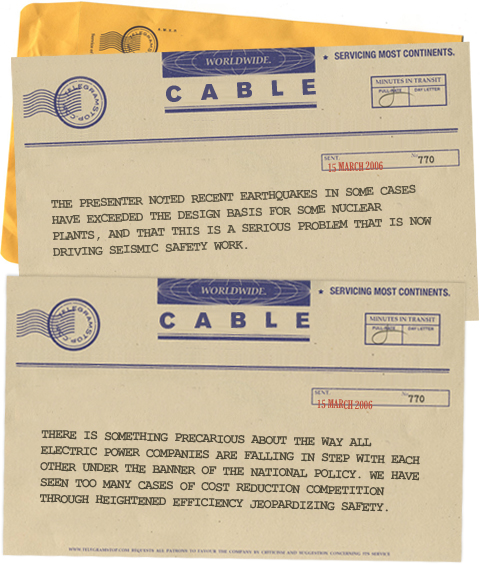
Submitted by volunteer editor Donna C. Originally found on Telegraph UK.


This entry was posted in Global, Graphics, Shocking and tagged . Bookmark the permalink.

We encourage users to engage in a respectful discussion of this post, below. Comments are not necessarily representative of MoveOn.org’s views or beliefs, nor are commenters necessarily MoveOn members. This is a community-moderated forum: If you see something offensive, please flag it. If a comment receives enough flags, it will be removed.

  • http://www.facebook.com/addison.rennick Addison Rennick

    The plant that was damaged was rated to withstand an 8.2. And it did. The tsunami was what caused the problems- it wiped out the diesel generators. They even had a huge bank of batteries for use in emergencies. And they worked too; even longer than they were supposed to.nnA 40 year old nuclear power plant was hit by the fifth largest earthquake in recorded history- much larger than Japan has EVER experienced- and was perfectly fine. If that doesn’t speak to the safety of nuclear power I don’t know what will.

  • http://www.facebook.com/profile.php?id=1004993206 Burr Hubbell

    Now is hardly the time for this kind of finger pointing. People are still dying. Grow up.

  • http://www.facebook.com/people/Ryan-Merket/136300045 Ryan Merket

    Hey Addison, it’s much too early to say that the earthquake didn’t damage the Japanese plants. In fact, they are now saying that the earthquake may have indeed damaged the inner protection wall of the 3rd reactor.

  • http://www.facebook.com/addison.rennick Addison Rennick

    Oh I don’t doubt it. nnBut no radiation was released from the earthquake. It was a lack of cooling, pools of molten uranium, and hydrogen explosions that caused a catastrophe.

  • http://twitter.com/bennetthall Bennett Hall

    this may all get down to who covered up what knowledge, when they knew “what”, and what if any protocol requirements would make them bound by duty to disclose the truth.

  • Anonymous

    @ Addison: nOh, well, if the earthquake was not responsible for emissions of radiation, then everything’s just fine, right? nnCatastrophes do happen. They happen when those who profiteer shrug off “the unexpected”, or “the unlikely”. They happen when corporate apologists nonchalantly look the other way when tragedy after tragedy – “unexpected”, “unlikely” – befalls a whole nation. They happen in the wake of a deadly arrogance of those who find the idea reasonable that a vast destruction of life – human, animal, vegetable, the earth itself, for centuries – is highly unlikely, and therefore do-able.nnBad earthquake! It wasn’t supposed to be bigger than an 8.2! Bad tsunami! It breached those well-built walls! Bad nature! Getting back on line was supposed to be a piece of cake!nnIf you like the odds for your safety so much, move to Sendai. After all, they’ve already had “the big one”. Probably won’t happen again. Chances are, you’re safe …nnAnd even if nothing had happened, there is no “disposing” of spent fuel rods. Only storage. Storage for half a million years. Storage where? Your basement? Feel safe now?nnIf nuclear power involves playing Russian Roulette with the safety of the planet, I don’t care if there are a million chambers and only one bullet. Nuclear power – like all highly concentrated power (political, chemical, financial, military) is – sooner or later – deadly.nn

  • Anonymous

    Thanks whybaby. I wish everyone would stop believing that nuclear power is safe in any way, shape or form. The waste alone is scary!nThe US wants another nuclear power plant…hope it’s not in my backyard!

  • http://www.facebook.com/addison.rennick Addison Rennick

    Even if you only consider China, official statistics put deaths from coal mining at over 6000. Just for 2004! Air pollution from coal burning causes an estimated 10,000 deaths per year. To get the same number 25 meltdowns would have to occur every single year.nnOf course deaths from coal burning air pollution are not noticeable, but the same is true for the cancer deaths from reactor accidents. In the worst accident considered, expected once in 100,000 melt-downs (once in 2 billion years of reactor operation), the cancer deaths would be among 10 million people, increasing their cancer risk typically from 20% (the current U.S. average) to 20.5%. This is much less than the geographical variation— 22% in New England to 17% in the Rocky Mountain states.nnThe risk of living in New york is many times greater than the worst case scenario of a total reactor meltdown and complete failure of all subsystems. But you wouldn’t know it watching the evening news.nnAnd the waste? Yeah there are reactors that have already been designed and are in construction that produce ZERO WASTE, or close to it. Some of them even burn the waste we’ve already produced. Nuclear waste is not going to be an issue forever.nnHumans are stupid.

  • http://www.facebook.com/people/Scott-Alexander-Thornton/100000357628428 Scott Alexander Thornton

    I’m sure the Japanese knew of the risks back in 1970 when they built the plant, which has worked well for 40 years. What’s your point?

  • http://twitter.com/RoyaleWihCheese RoyaleWihCheese

    Absolutely. If anything, this OUGHT to spur US design and construction of traveling-wave reactors that can consume spent waste. Not only does it drastically reduce the amount of waste we already have sitting around, but it converts just the waste we have laying around into enough power for 200 years. Would you rather the spent fuel sit around in a pool, like it did at Fukushima, get buried in your “backyard”, or in a reside in a heavily contained reactor producing clean power?

  • http://www.facebook.com/profile.php?id=590554557 Kristian Townsend

    I notice that this is in english and not japanese. Why is it not in japanese? – It makes me suspicious that it is not genuine.

  • http://www.facebook.com/profile.php?id=590554557 Kristian Townsend

    I notice that this is in english and not japanese. Why is it not in japanese? – It makes me suspicious that it is not genuine.

  • http://twitter.com/arnesinnema arne sinnema

    Currently I’m doing the master study Sustainable Energy Technology at the TU-Delft in Holland. nTwo things have become clear: n1 greenhouse gas emissions are probably the single largest threat to human civilization. n2 most renewable energy sources (solar, wind etc…) have one big problem and that is continuity. Meaning when the sun doesn’t shine a pv-panel doesn’t produce electricity. To be completely reliant on pv and wind would mean (large) investments in energy storage. nnOf course the risks of nuclear energy are currently vividly shown by the extensive media coverage of the Japan nuclear accident, little attention is given to the risks of not using nuclear energy as a source of carbon free energy.nWe should in a very short timespan move away from fossil fuels. CO2 the main greenhouse gas is currently at ~390ppm (parts per milion) increasing rougly 2ppm/year, 450ppm has been mentioned as a critical threshold, which at this rate would take ~30 years.nYes nuclear waste is one of the problems but so is CO2 which stays for thousands of years in the atmosphere!nOn the other hand replacing all conventional power with nuclear power in a couple of decades is simply not possible because the plants cannot be built fast enough, so it’s only part of the solution.nIn my opinion the discussion should not be nuclear power or not, but how can we as fast as possible reduce greenhouse emissions to a reasonable level, until that time disregarding nuclear energy is a luxury we can’t afford!

blog comments powered by Disqus